Home
We remove all types of load bearing walls & fix structural related problems.
What is a load bearing wall?
A house of cards succinctly illustrates the concept of load-bearing walls; every horizontal card must be supported by vertical cards; and as  cards build upward, their weight bears down on the lower walls. A real house works the same way, except that the load-bearing walls aren’t so easy to locate. Identify these important walls using a few rules that apply broadly to buildings before starting your project. Always remember, though, that even if it doesn’t fit one of these categories, it might still be a load-bearing wall.
When a house is built, load bearing and non-load bearing walls are created. The difference between these walls is what you’d probably imagine – some are responsible for shouldering the structural weight of the building, while others (often called “curtain walls”) are purely for dividing rooms and don’t hold anything up. Before modifying any walls in your home, it’s important to be very sure which walls are and aren’t load bearing, as removing or modifying a load bearing wall can compromise your home’s structural stability with potentially disastrous consequences.
How to Determine which one is a loadbearing wall?
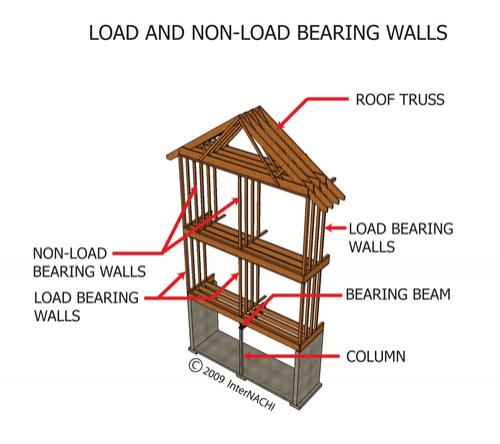
To begin determining which walls in your house are load-bearing ones, it’s best to start at the most basic load-bearing feature of any home – the foundation. If your house has a basement, start here. If not, try to start wherever on the first floor you can locate your house’s lower concrete “slab.”
- Once you’ve reached your house’s lowest point, look for walls whose beams go directly into the concrete foundation. Your house’s load bearing walls transfer their structural strain into a sturdy concrete foundation, so any walls that interface directly with the foundation should be assumed to be load bearing walls and should not be removed.
- Additionally, most homes’ exterior walls are load bearing. You should see this at the foundation level – whether wood, stone, or brick, nearly all exterior walls will extend right into the concrete.
Effects of renovation on existing walls.
It is easy to understand how renovations can cause weight to be transferred onto formerly non-load bearing partition walls. For example, the addition of exhaust fans and attic stairways often requires cutting of ceiling joists, which can also transfer loads from the original walls… the main (center of the house) beam and the outside wall, onto non-load bearing walls that are in between them. Adding a room in an attic can change the entire load bearing status of the walls below.
The best advice if you are planing to remove a load bearing wall.
One of the most important skills for any do-it-yourselfer is to know when not to. If you have a project in mind, like Removing a structural wall or a post or a project that involves skills (and tools) outside of your knowledge, turning to professionals is a good choice, likely we are here to help our prices are competitive and we will get the job done right, It is best to be safe and stay on the side of caution and consider every wall as load-bearing until it has been confirmed by a professional.
How can a load bearing wall or a post be removed?
A load bearing wall can be removed, but a new system for transferring the weight has to be built. The most common way to solve this is by building a new header and post structure to go in place of the wall, So, a load-bearing wall can be reconfigured to accommodate a new interior design, as long as the identification and construction is done by building professionals with a deep understanding and the experience to change important structural elements, we provide a consultation service to accurately identify load-bearing walls in a home and will help map out the best way to proceed on a remodeling project that may require the alteration or removal.